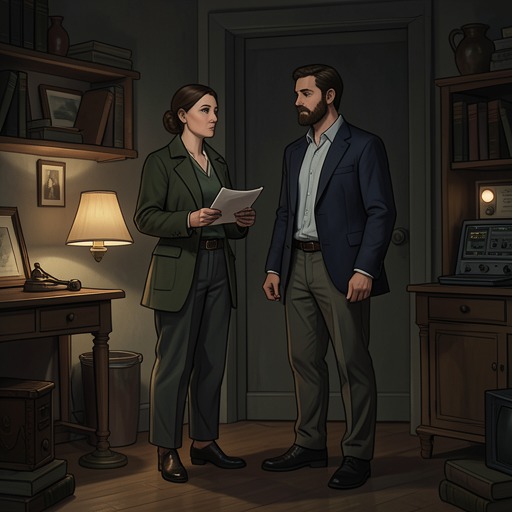
Elle and Lee’s Late-Night Reconciliation
The Kissing BoothElle and Lee’s Late-Night Reconciliation is a midnight phone call in which Elle takes the first step toward repairing her friendship with Lee after he discovers her secret relationship with Noah. The exchange leaves the breach intact—Lee remains angry that they kept the relationship from him—but turns uncertainty into a more durable understanding: he does not hate Elle, will still take her to school, and still loves her. Reconciliation here is not instant absolution; it is care continuing in the presence of hurt.
Causes and Background
The call begins with Elle unable to sleep. She is worried about both brothers, but distinguishes their situations: she believes Noah can look after himself, while Lee cannot simply put a Band-Aid on what has happened and be all right. Her attention to Lee’s hurt gives the call its urgency. The secret relationship has endangered not only her connection with Noah but the childhood friendship through which Lee has long been part of her life.
At midnight, Elle’s resolve to wait gives way. She reaches for her cell phone and speed-dials number two. The small practical detail establishes the intimacy of the action: rather than composing a message or waiting for a chance encounter, she calls directly, despite not knowing whether Lee will answer or how he will respond. The phone rings repeatedly and comes close to going to voicemail before he picks up and calls her Shelly. His familiar name for her makes the conversation begin inside their old closeness, even as its subject is the deception that has damaged it.
Apology and Anger
When Lee asks how she is, Elle admits that she does not know. She apologizes and says she never meant for events to happen this way. Lee does not let intention stand in for responsibility: he answers that she still let the relationship happen. Elle accepts the distinction, calls her own conduct a serious mistake, and gives him the explanation she had been unable to offer before.
She says that concealing the relationship had seemed like the best option because she expected Lee to be hurt by the thought of her secretly seeing his brother. She had kept meaning to end the relationship, hated lying to Lee, and nonetheless allowed the concealment to continue. She also says she thought the relationship might not work out and that withholding the truth would protect him from becoming involved. The explanation does not excuse the lie: Lee’s response is that she kept the truth from him all that time, and that Noah did too. His anger is sharpened by the contrast between the brothers’ former hostility, when Elle thought they could scarcely share a room without arguing, and the relationship they had secretly formed.
A brief, uneven laugh interrupts the apology. Lee calls Elle’s admission an understatement, but she hears a chuckle in his voice that he tries to disguise as a cough, and she laughs too. The moment does not settle the argument. Instead, it makes room for the two familiar friends to speak through it: humor returns for a beat, while the underlying grievance remains plainly stated.
The Call’s Turning Point
After Elle finishes explaining, Lee says nothing for a long while. She knows he is still there from his breathing on the phone, but the silence leaves her without reassurance. She is close to tears and tries not to cry; even without seeing her, she thinks Lee would recognize it. Their distance is therefore both literal and limited: they cannot see one another, yet Elle expects him to know her well enough to hear what she is trying to hide.
Unable to bear the uncertainty, Elle asks whether Lee hates her. His answer is hesitant and deliberately qualified. He says that he does not hate her, while making clear that he does not like her very much at that moment. This is the call’s central turn, not a declaration that everything is forgiven. Lee names the immediate damage without converting anger into rejection. The distinction gives Elle a truthful answer she can live with: their friendship is wounded, but not ended.
Care, Love, and Consequence
A yawn shifts the exchange toward its close. Lee tells Elle to get some sleep and says he will see her in the morning. She asks whether he still plans to take her to school, and he answers that he does, treating the ride as an ordinary obligation between them rather than withdrawing it in punishment. His practical promise becomes the clearest evidence that the argument has not erased his care.
Just before the call ends, Elle asks Lee whether he knows she loves him. He says that he does and returns the sentiment, while adding that loving her does not mean he has to like her all the time. Elle is smiling when she agrees. The ending holds affection and annoyance together instead of forcing one to cancel the other. The next morning’s ride is promised, but the hurt is not declared repaired in full; what the call restores is the possibility of continuing their friendship while Lee is still angry.
The scene is told through Elle’s first-person account, so Lee’s feelings reach the reader through his words and through what she hears in pauses, breath, and tone. The long wait before he answers, the silence after her explanation, and the careful qualification of his answer make the reconciliation unfold by degrees. Its decisive gestures are modest—a returned call, a school ride, an exchange of love—but their ordinariness matters: after the secret has altered how Lee understands both Elle and Noah, he still makes room for Elle in the routine of the next day.